
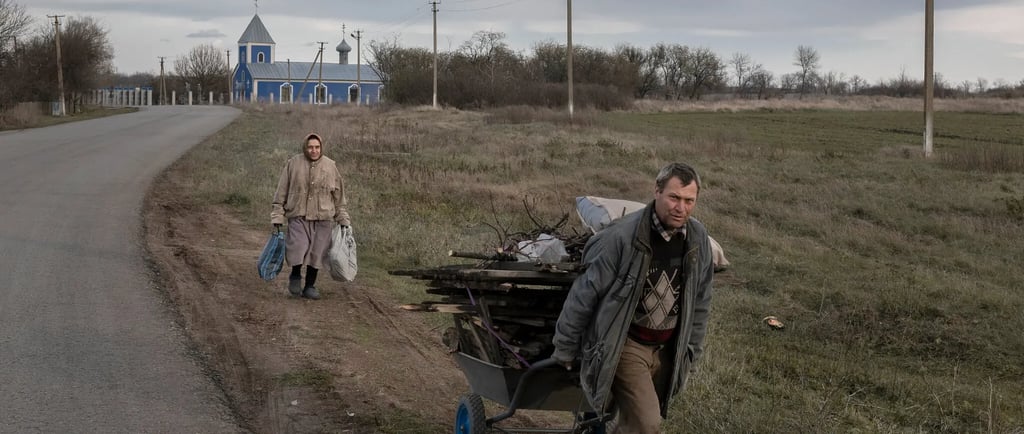
For us - it's already winter
Joseph Nichols
7/27/20264 min read
Ukraine Is More Than Its Cities
When people think of Ukraine today, they often picture Kyiv's skyline or the heavily bombarded cities that make the evening news. Those images are real—but they tell only part of the story. Ukraine is also thousands of villages, hundreds of small towns, and millions of people living in places that rarely appear in headlines. Each has its own challenges, and each requires a different approach to humanitarian assistance.
Ukraine's major cities remain the country's economic engines. They have larger hospitals, better transportation networks, stronger communications, more government offices, and greater access to public services. They also attract the majority of international organizations because they are easier to reach, safer to operate in, and allow aid agencies to assist large numbers of people from centralized locations.
Small towns occupy the middle ground. Many have lost businesses, young workers, and local industries since the war began. As internally displaced families have arrived from frontline communities, these towns have been asked to support growing populations with schools, clinics, housing, and infrastructure that were never designed for such demand. They continue to function, but often with limited resources and strained local budgets.
Then there are the rural villages.
Nearly 30% of Ukraine's population lives in rural communities, while millions more live in small towns. Since the full-scale invasion began, millions of women and children have fled abroad, and countless households inside Ukraine are now led by women whose husbands, fathers, or sons are serving in the Armed Forces, have been displaced, or have been killed. In many villages, the remaining population is disproportionately elderly.
These older residents are among the most vulnerable people in Ukraine.
Many have spent their entire lives on the same land. Their homes, gardens, orchards, and livestock are more than possessions—they are their livelihood, their memories, and their connection to generations of family history. Most have neither the financial means nor the desire to leave. Others simply have nowhere else to go.
The war has widened the gap between urban and rural life.
Government resources must naturally focus on maintaining the infrastructure that serves the greatest number of people—major highways, hospitals, electrical systems, schools, municipal services, and emergency response capabilities concentrated around larger population centers. International humanitarian organizations face similar realities. With limited funding, personnel, and transportation, they often have to maximize the number of people helped at each delivery point.
That means one truck delivering aid into a city may assist hundreds of families in a single location.
Reaching those same hundreds of people in scattered villages may require driving hundreds of additional kilometers, making dozens of individual stops, crossing damaged roads, and spending an entire day reaching communities that may contain only a few dozen households.
It is not because rural communities are less important.
It is because they are much harder—and much more expensive—to reach.
As a result, many smaller communities depend heavily on local volunteers and smaller humanitarian organizations willing to travel the extra distance. These are often the places where the need is greatest, but where assistance arrives least frequently.
The practical challenges are significant.
Roads are damaged or poorly maintained. Bridges have been destroyed. Cellular service is often unreliable, especially during extended power outages. GPS navigation is not always dependable, and many villages are connected only by narrow country roads that become difficult to navigate after heavy rain.
Then winter arrives.
Snow, ice, freezing temperatures, and prolonged power outages can isolate entire communities for days. A trip that might require thirty minutes during the summer can become a two- or three-hour journey—or become impossible altogether. Fuel consumption rises, vehicles suffer greater wear, communications become less reliable, and every delivery requires more planning, more volunteers, and more resources.
This is one reason humanitarian work in rural Ukraine looks very different from humanitarian work in the cities.
It is slower.
It is more expensive.
It reaches fewer people per trip.
Yet for the people receiving that assistance, it may be the only help they see for weeks.
At Care4Ukraine.org, we have intentionally focused much of our work on these overlooked communities across eastern Ukraine. We work with elderly residents, families, and internally displaced people living in villages and small towns—not because they are easy to reach, but because too often they are forgotten.
Every food package, every medical delivery, every welfare visit, every emergency communication check, and every kilometer traveled represents one more family that knows they have not been abandoned.
This is also the time of year when we begin preparing for winter.
Although the war has dramatically increased humanitarian needs, winter has always been one of the greatest challenges in Ukraine. Cold temperatures, snow, ice, power outages, and isolation affect vulnerable families every year, regardless of the security situation.
Care4Ukraine.org has been working in Ukraine since 2015, and one lesson has been reinforced every single year: winter preparation cannot begin in autumn—it must begin in summer.
By the time the first cold weather arrives, everyone is looking for the same essential items—food staples, heating supplies, warm clothing, blankets, generators, medical supplies, fuel, and emergency equipment. Prices rise, inventories shrink, transportation becomes more difficult, and deliveries into rural communities become increasingly unpredictable. Waiting until autumn often means paying more, finding less, and reaching fewer people.
Experience has taught us that the only responsible approach is to build our winter inventory early. Throughout the summer, we purchase and stage the supplies that we know families will need months later, before shortages begin and before weather makes deliveries significantly more difficult.
This preparation is one of the reasons we are able to continue serving communities throughout the winter, when travel becomes slower, conditions become harsher, and the need is often at its highest.
Your support today does far more than help someone today—it helps ensure that we are ready when winter arrives.
If you would like to help us prepare for the months ahead, please consider making a contribution at Care4Ukraine.org. Every donation helps us purchase supplies while they are still available, transport them into eastern Ukraine before winter sets in, and ensure that they are where they need to be when families need them most.
If a donation isn't possible today, you can still make a meaningful difference by following our work, sharing our mission with others, and subscribing to our bi-weekly newsletter beginning in August.
The greatest needs are not always found where the television cameras are.
Sometimes they are found at the end of a long country road.
Connect
info@care4ukraine.org